GovWell Plan Review
Modernizing the review process for local governments Inspectors
Context
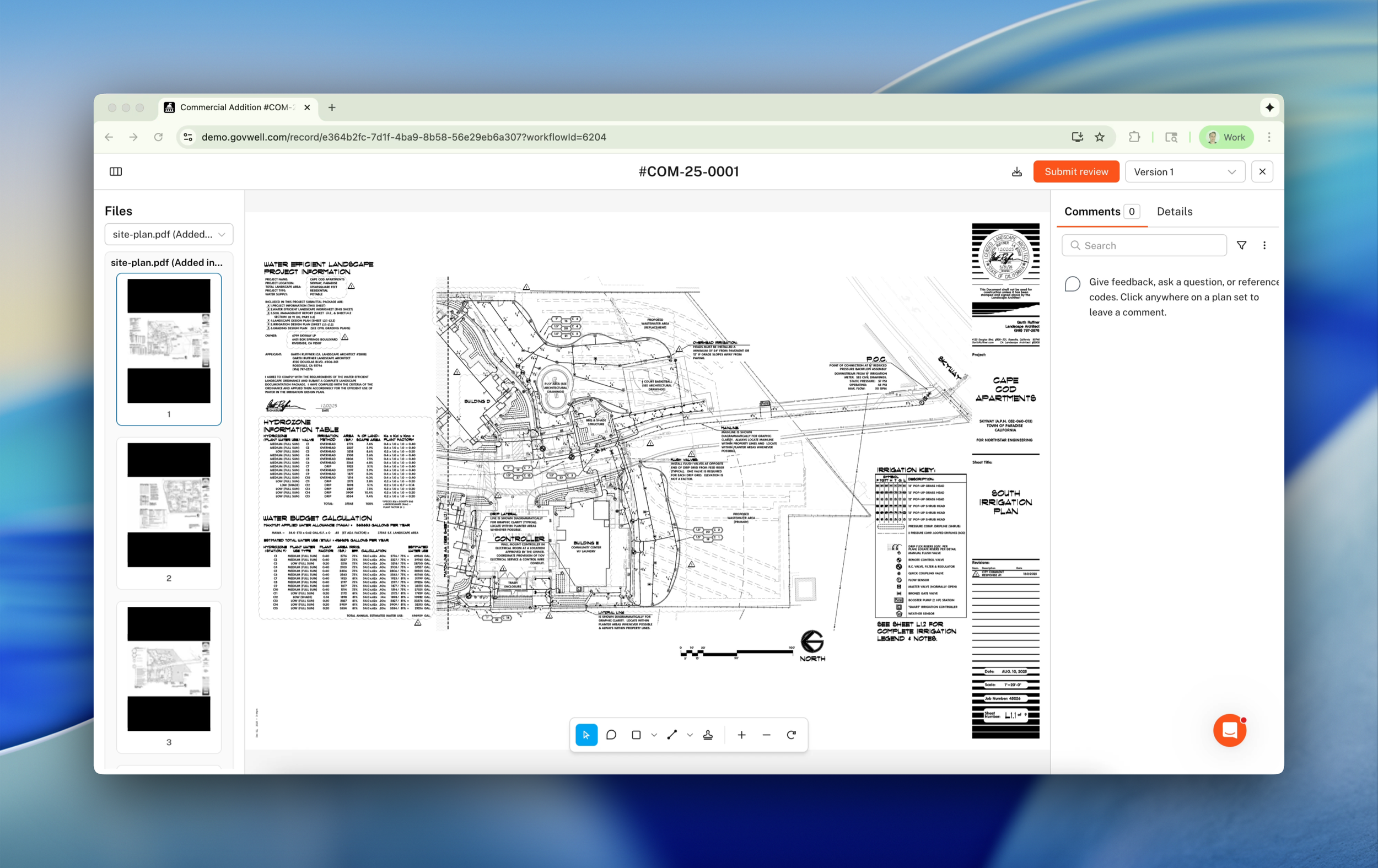
This was my first major project after joining GovWell: designing a 0→1 integrated Plan Review experience that would allow government staff to complete an entire permit record—from intake to decision—without leaving our platform.
During early discovery calls, we noticed a major gap:
Customers were exporting plan sets and switching to third-party tools to complete core review workflows.
That created user friction, inconsistent records, and broken audit trails. Closing this gap became critical to launching a competitive permitting solution.
This project resulted in [insert results: reduced turnaround time / increased adoption / X% more reviews completed internally].
TEAM
1 CTO
1 Designer
1 Full-Stack Engineer
MY ROLES
Strategy,
Competitive Research,
Experience Design,
User Research,
Visual design
PROJECT TIMELINE
July 2025
The Challenge
Local governments struggle with outdated, paper-heavy plan review processes that are:
Time-consuming
Error-prone
Non-collaborative
Lacking transparency for both reviewers and applicants
Reviewers and applicants need a modern, digital workflow that:
Reduces repetitive tasks
Centralizes feedback
Enables faster turnaround
Provides a single source of truth across departments
The Users
Municipal plan reviewers are public servants managing heavy workloads of building applications. They vary significantly in:
Technical proficiency (from novice to expert)
Role (planning, fire, engineering, zoning)
Department size and structure
Available time
Designing a tool for them required striking the right balance:
Simple enough for a junior reviewer, powerful enough for a seasoned inspector while providing insights to applicants.
"We're drowning in paper. Tracking which version of plans we're reviewing and what changed between submissions is nearly impossible."
— Alicia Dixon, Building/Onsite Permit Technician, Paradise, CA
"…I have to keep moving across GovWell and Bluebeam to finish reviewing applications, right now it’s still easier to work on paper for us."
— Aaron Gillum, Building Inspector, Hutto, TX
"There's no visibility into where plans are in the review process. Applicants call constantly asking for status updates, and we waste time tracking down information manually."
— Jonathan Fanning, Building Inspector, Decatur, TX
Understanding the Problems
Problem 1 — Incomplete end-to-end permit workflows
Reviewers couldn’t complete plan reviews inside GovWell; they had to export PDFs to external tools. This created data fragmentation, slowed teams down, and made GovWell feel incomplete.
Problem 2 — Inability to give clear, async feedback on plan revisions
Reviewers had no structured way to provide comments or request revisions. This forced them into email threads or sticky notes on printed plans.
Problem 3 — Long turnaround times
Without digital workflows, review cycles were slow and untrackable. Users couldn’t easily identify what changed between versions or who was waiting on whom.
Problem 4 — No auditability or accountability of feedback
Feedback was scattered across email, PDFs, physical copies, and shared drives.
The Solution
GovWell Plan Review is a comprehensive digital platform that replaces outdated, paper-based processes with a streamlined, transparent system. The solution enables reviewers to efficiently manage submissions, collaborate with stakeholders, and track progress through every stage of the review cycle.
Key Features
Markups and Measurement
To solve end-to-end workflow gaps, we introduced native tools for: drawing shapes and markups, measuring distances and areas, and commenting directly on plan sheets. This allowed all review work to happen within GovWell—no exports needed.
Plan Version Comparison
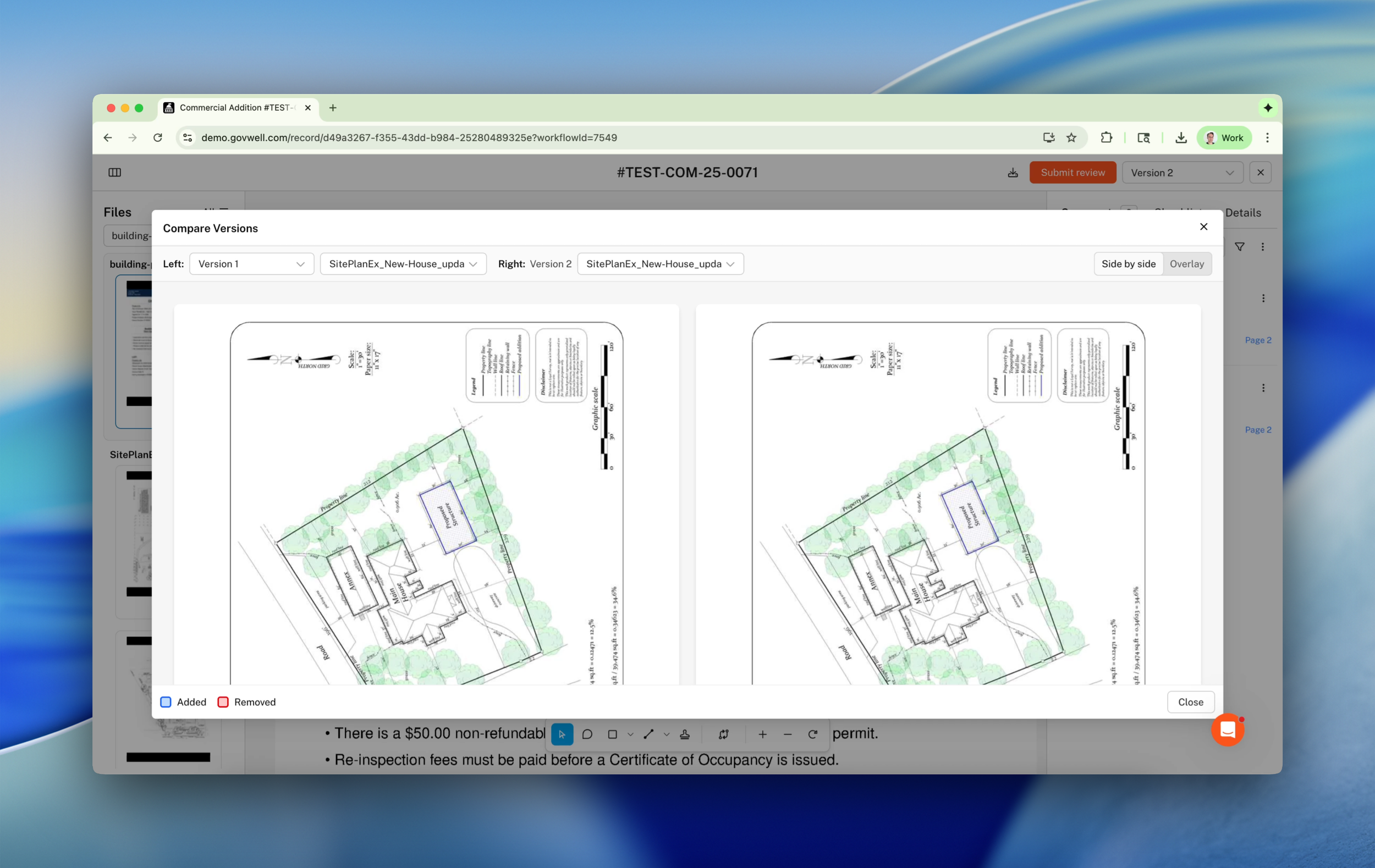
I designed side-by-side and overlay comparison tools that allow reviewers to instantly identify changes between plan submissions. A "Modified" badge automatically appears next to any documents that differ from the previous version, eliminating the time-consuming task of manually comparing plans.
This feature addresses the critical pain point of tracking version changes, enabling reviewers to focus their attention on what actually changed rather than spending hours cross-referencing documents.
Stamp Template Management
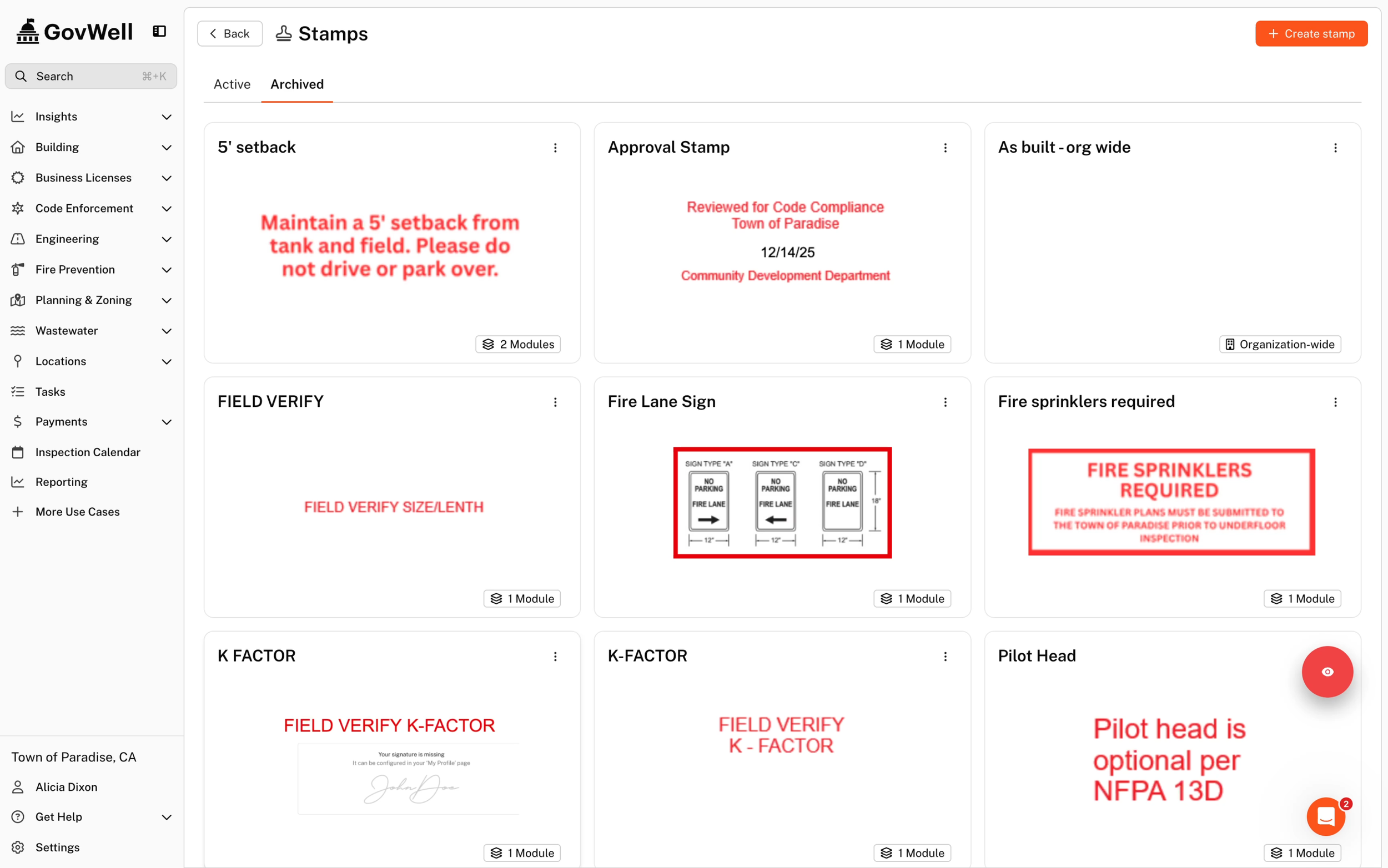
Inspectors often use stamps for approvals, rejections, or conditional notes. We added the ability to add custom and agency-provided stamp uploads, drag-to-place functionality, resize and rotation, ability to remove backgrounds from scanned existing stamps, and audit logging of who applied what stamp and when.
Automated Corrections Report
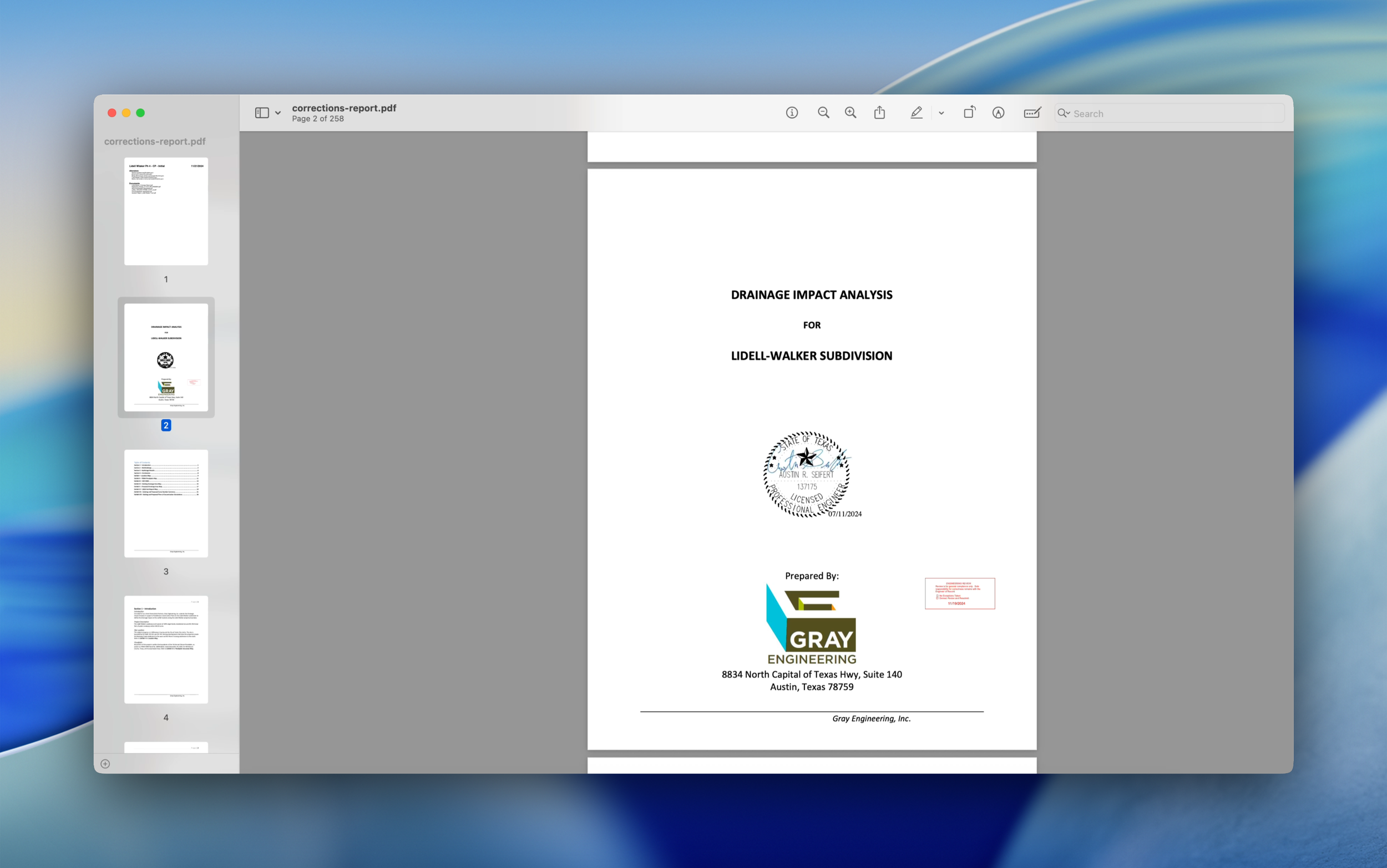
We automated the process of turning markups into structured correction items. Now reviewers can convert annotations into standardized correction reports, reports are automatically emailed to applicants, and reduce manual work and ensure consistency. This cut out hours of manual PDF or paper editing per review cycle.
Feedback & Iterations
Through weekly feedback sessions with planning and engineering reviewers, we made iterative improvements:
Stamps Configuration
Improved placement controls
Added agency-wide stamp presets
Allowed free movement and layering
Markup Editing
Precision resizing
Color and style controls
Undo/redo improvements
File Overlay
Side-by-side version comparison
Overlay transparency slider
Highlighting changes between uploads
Other Enhancements
Faster PDF rendering
Improved loading of large plan sets
Clearer UI hierarchy for annotations vs. comments
Learnings
Meet reviewers where they are. Many aren’t designers or engineers, simplicity wins.
Government workflows depend on accountability. Audit trails weren’t optional, they were essential.
0→1 features require tight collaboration. Fast cycles with engineering and CTO alignment were crucial to shipping meaningfully in four weeks.
Adoption is earned. The easier we made the workflow, the faster teams embraced it.
Conclusion
The Plan Review experience transformed GovWell from a permitting intake tool into a fully integrated review platform. By closing the workflow gap, we increased product stickiness, improved turnaround times, and helped municipalities modernize one of the most painful steps in permitting.